
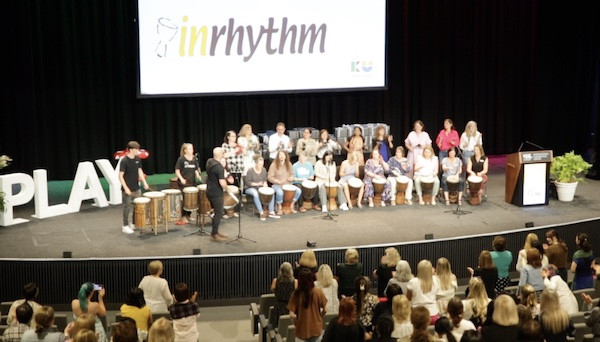
Give staff practical, evidence-informed tools they can use tomorrow. This immersive training equips teachers to lead inclusive drum and rhythm circles that build connection, focus, and joy across the school community—no musical experience required.
See Full Program Overview View Public Intakes & Dates
Why It Works in Schools
Rhythm is accessible to every learner. Guided drum and rhythm circles create immediate inclusion, regulate energy, and strengthen social cohesion—while building confidence and creativity in a low-pressure, fun environment.
Benefits for Students & Staff
- • Supports emotional regulation, attention, and stress reduction.
- • Improves teamwork, communication, and classroom culture.
- • Builds confidence, creativity, and leadership through ensemble making.
- • Promotes mindfulness & present-moment focus (direct-experience techniques).
- • Creates safe, joyful spaces for connection and belonging.
Curriculum Alignment & Teacher Standards
The training aligns with the Australian Curriculum: The Arts (Music) — Making (Performing/Composing) & Responding — and supports General Capabilities (Personal & Social, Critical & Creative Thinking, Intercultural Understanding, and Wellbeing).
Relevant Australian Professional Standards for Teachers (APST): 2.1 (content & strategies), 3.3 (teaching strategies), 3.4 (resources), 3.5 (classroom communication), 4.1 (student participation), 6.2 (professional learning & practice).
Formats & Delivery
- • PD Hours: Typically 12–14 hours (e.g., 2 full days) — can be split into staff-meeting blocks or a pupil-free day.
- • On-site at your school: Up to ~30 staff per cohort (ask us about larger groups).
- • Public intakes: Teachers can join our city/regional training dates.
- • Private cohorts: Cluster schools or multi-campus groups welcome.
What Teachers Learn
- • How to lead inclusive drum & rhythm circles for any class (K–12)
- • Non-verbal conducting, call-and-response, and group-energy flow
- • Simple polyrhythm, body percussion, and ensemble skills
- • Mindfulness through rhythm: focus, presence, and regulation techniques
- • Behaviour-safe games & structures that build confidence and collaboration
- • Adapting sessions for wellbeing days, assemblies, SEL blocks, and after-school
What You Receive
- • 8-Week Program — week-by-week lesson plan (scaffolded for K–12)
- • One-Off Session templates (30–90 minutes) for events and wellbeing days
- • Rhythm charts & exclusive backing tracks to keep the groove while you facilitate
- • Facilitator Manual & Workbook + ongoing access to updates
- • Certificate of Completion (approx. 12–14 hours PD)
Evidence-Informed Approach
Research increasingly links group drumming and meditation to reduced anxiety, improved mood and social engagement, and positive effects on attention and stress. Our method integrates rhythm with practical mindfulness to support real-world classroom outcomes. See research Articles Here
Teacher PD — Frequently Asked Questions
Do staff need musical experience?
No. The PD is designed for absolute beginners through to confident musicians. We focus on inclusive facilitation, simple patterns, and group confidence.
Do we need to supply drums?
We can supply instruments or work with what you have. We also include body-percussion options so activities remain fully accessible without gear.
How many staff can we train at once?
Typically up to ~30 staff per cohort for optimal interaction. Larger cohorts are possible—ask us about staging and rotating formats.
Can we split the PD into shorter blocks?
Yes. Common formats include two full days, a pupil-free day, or multiple 60–120-minute after-school sessions across the term.
Is it aligned to curriculum and APST?
Yes. It supports Australian Curriculum: The Arts (Music) — Making/Responding — and aligns with APST 2.1, 3.3, 3.4, 3.5, 4.1, 6.2.
Which year levels is this suitable for?
K–12. Activities scale for early primary through to secondary, with guidance on adapting challenge, tempo, leadership and reflection.
What outcomes can we expect in classrooms?
Improved attention and regulation, stronger class cohesion, creative confidence, clearer non-verbal communication, and practical mindfulness.
What space and noise levels are required?
A hall or large room is ideal. We moderate volume using instrument choice, sticks/mallets, muting, foam underlays, and body-percussion options.
How much does it cost?
Pricing varies by cohort size, location and format. Enquire for a tailored PD package or see public intake dates.


Teacher PD: Drum & Rhythm Facilitator Training (K–12)
Give staff practical, evidence-informed tools they can use tomorrow. This immersive training equips teachers to lead inclusive drum and rhythm circles that build connection, focus, and joy across the school community—no musical experience required.
See Full Program Overview View Public Intakes & Dates
Not quite ready to book?
Enter the draw to win a place in our upcoming Facilitator Training
For educators & wellbeing practitioners exploring rhythm-based engagement
(Double Pass Valued at $1500)
Why It Works in Schools
Rhythm is accessible to every learner. Guided drum and rhythm circles create immediate inclusion, regulate energy, and strengthen social cohesion—while building confidence and creativity in a low-pressure, fun environment.
Benefits for Students & Staff
Curriculum Alignment & Teacher Standards
The training aligns with the Australian Curriculum: The Arts (Music) — Making (Performing/Composing) & Responding — and supports General Capabilities (Personal & Social, Critical & Creative Thinking, Intercultural Understanding, and Wellbeing).
Relevant Australian Professional Standards for Teachers (APST): 2.1 (content & strategies), 3.3 (teaching strategies), 3.4 (resources), 3.5 (classroom communication), 4.1 (student participation), 6.2 (professional learning & practice).
Formats & Delivery
What Teachers Learn
What You Receive
Evidence-Informed Approach
Research increasingly links group drumming and meditation to reduced anxiety, improved mood and social engagement, and positive effects on attention and stress. Our method integrates rhythm with practical mindfulness to support real-world classroom outcomes. See research Articles Here
Teacher PD — Frequently Asked Questions
Do staff need musical experience?
No. The PD is designed for absolute beginners through to confident musicians. We focus on inclusive facilitation, simple patterns, and group confidence.
Do we need to supply drums?
We can supply instruments or work with what you have. We also include body-percussion options so activities remain fully accessible without gear.
How many staff can we train at once?
Typically up to ~30 staff per cohort for optimal interaction. Larger cohorts are possible—ask us about staging and rotating formats.
Can we split the PD into shorter blocks?
Yes. Common formats include two full days, a pupil-free day, or multiple 60–120-minute after-school sessions across the term.
Is it aligned to curriculum and APST?
Yes. It supports Australian Curriculum: The Arts (Music) — Making/Responding — and aligns with APST 2.1, 3.3, 3.4, 3.5, 4.1, 6.2.
Which year levels is this suitable for?
K–12. Activities scale for early primary through to secondary, with guidance on adapting challenge, tempo, leadership and reflection.
What outcomes can we expect in classrooms?
Improved attention and regulation, stronger class cohesion, creative confidence, clearer non-verbal communication, and practical mindfulness.
What space and noise levels are required?
A hall or large room is ideal. We moderate volume using instrument choice, sticks/mallets, muting, foam underlays, and body-percussion options.
How much does it cost?
Pricing varies by cohort size, location and format. Enquire for a tailored PD package or see public intake dates.
Pricing
Pricing varies by cohort size, location, and desired outcomes. We’ll tailor a PD format to suit your timetable (including split blocks).
Enquire for a School PD Package | See Upcoming Public Dates | View Full Facilitator Training Overview
ENTER THE DRAW
Facilitator Training